
More than just pleasing our ears, music possesses an uncanny ability to entwine itself with our sense of taste, a phenomenon deeply explored in the world of sound branding. Tune in as Lucy Blanco hosts a captivating conversation with Pavle Marinkovic, a leading sound expert, exploring the profound impact of music on our emotions and consumer choices. From exploring the intriguing dynamics in food shopping experiences to diving into the mesmerizing realm of film scoring, they leave no sonic stone unturned. Plus, gain insights from Pavle’s groundbreaking book, Sounds From Farm To Fork (And Back). This episode is surely a treat for your ears and mind!
—
The Secret Power Of Sound Branding With Pavle Marinkovic
My very special guest today is an audio branding consultant who graduated with honors, earning a degree in Psychology in Santiago de Chile, and a master’s degree in Film Scoring from Barcelona, Spain. He’s written How to Hook Your Consumer With Music, a six-step evidence-based guide, and spreading the word about the power of music in different domains, in his newsletter, Sound Awareness. My guest is also a violin and keyboard player, music teacher, film composer, blogger, and award-winning writer at Medium. He’s very passionate about different facets of music, which are deeply intertwined with his daily work. His name is Pavle Marinkovic. Welcome Pavle to the show.
Thank you for having me, Lucy.
Music And Consumer Preferences
It’s a pleasure. Thank you so much for this time. We’re going to learn about the connection between music and our sense of taste and the enigmatic power of sound on our psyche. Pavle, as the sound expert that you are, tells us the power music has in provoking emotions that can lead us to have certain preferences as consumers.
First of all, it’s important to understand that music elicits emotions in different ways. Think about sound in its simplest form without the influence of lyrics, harmony, or other musical elements. A sudden sound can scare us before we even know what’s causing it. It activates our fight-or-flight response. Now add a layer to this. In this case, the emotional reaction happens when you react to a song because of an association between the song and your surroundings. Let’s say you get together with your friends and you always sing certain songs. Lucy, what would these be in your case?
A beat, the drums.
In my case, it would be some folk songs I used to play with my band. After doing this several times, you’ve created a link between music and emotion. Let’s say joy in this case. The bond becomes stronger with repetition. Now, when you listen to that song, if there’s no friendly reunion, you’ll feel the same emotions, maybe not at the same intensity level, but they’re there.
You’ve paired a song with a situation or a person and an emotion. That’s what brands try to do. Let’s say a coffee shop usually plays jazz songs when you go there. You’ve gone there several times and always had a good time. Now, if you go there again. It reminds you of those emotions because of the jazz songs and other elements even if you’re not with the same people. It’s the power of association. Music experience and emotion bind together.
That’s super awesome and of course, that’s what triggers that dopamine rush that leads you to purchase something. That’s super awesome and what about the atmospheric, can you explain that and the illicit emotions that awaken the senses?
It’s all about pairing the right music with the right product or service. Before the 1970s, businesses weren’t that aware of how to craft their environment to evoke a specific emotional response, either to increase the likelihood of a purchase or boost the customer’s experience but then the Marketing Guru called Philip Kotler introduced the idea of atmospherics, where you could design the sensorial experience to affect the customer, sometimes even more than the product itself.
Kotler talked about manipulating the smell, the visuals, and the sound element to make us more relaxed, excited, nostalgic, or evoke any other emotion. Once you experience a certain mood, you link that emotional response with what’s in front of you. In this case, the product. Making it seem more appealing, the brand more relatable, or the shopping experience more enjoyable.
For instance, Dunkin’ Donuts used several senses to direct people’s morning routine toward choosing their coffee. While people were on the bus, let’s say going to work, they would play a catchy jingle. They would also release an aroma of coffee and when they got off the bus, they would see an ad telling them where the closest Dunkin’ Donuts was.
They conditioned people to link Dunkin’ Donuts with their morning coffee, an association they didn’t even have before. This example shows us the impact of strategic influence on our senses to change our preferences. Music transforms not only how we see the brand, but also how we feel about it on a deeper and more unconscious level.
The sense of smell lasts for years. For example, in my particular case, personally speaking, I can smell a fragrance now, say a cologne. If I didn’t like that person, right, if I didn’t like the guy, then I would associate that fragrance with that person that I knew, and this goes back years ago. That stays in your mind for years. The same with food, am I right? When you’re in a restaurant, you’re not aware.
I think that’s so fascinating, Pavlet. Being in a restaurant and enjoying the food and then ordering more or being in a bar and realizing that, you know, the boom, boom music is there on purpose. As consumers, we’re not aware of it. How about buying food online versus brick-and-mortar? Which one’s more effective, do you think?
Both platforms offer different aspects of the consumer experience. Online shopping provides convenience. It’s efficient, it’s quick, and you buy it from anywhere. Physical stores offer something that online platforms cannot replicate. It’s an immersive, this multi-sensory experience. When you shop in a store, you activate all five senses, which can enhance the consumer’s connection to the product or brand.
Most platforms offer different aspects of the consumer experience. Online shopping provides convenience. It’s sufficient and quick. You can buy from anywhere, but physical stores offer something that online platforms cannot replicate. It’s the immersive multi-sensory experience.
In this scenario, music can influence the perception of time. Let’s say you can make people think more time or less time has passed. It can enhance their moods and even affect their spending behavior. I think the future of shopping likely involves a hybrid, ensuring the consumer receives both the convenience of online shopping and the rich and immersive experiences of physical stores.
Very interesting. What about that chocolate factory that you were in in Madrid in which you did a taste test with music? Could you tell us about that? Expand on that.
There’s a vegan chocolate factory in the center of Madrid. I experimented there because people would go on tours and see how the chocolate was made. Before the tour would commence, I would ask them to participate in this test. I would give them a piece of chocolate from one bowl and ask them to taste it while they were listening to either high-pitched music or low-pitched music. Then I would ask them to rate this. Is it sweet? Is it bitter? How do you feel about the piece of chocolate you’re tasting?
Then I would do the same. They would take another piece of chocolate from another bowl and they would do the same. If they first listened to high-pitched music, now they would listen to low-pitched music or the other way around. The results were fascinating. People linked high-pitched music, which would be piano music at the high end of the keyboard or chime bells with the taste of sweetness.
It made the chocolate taste sweeter and a high pitch equals sweet and then you have a low pitch equals bitter. This would be bass sounds or cello in the lower end. Then I would tell them, that it was the same chocolate in both instances. I just put them in two bowls and they were baffled. They wouldn’t think that that was possible because they’ve never thought about sound this way, that it could influence their experience of taste. This shows that the eating experience is much more than the smell and taste. It’s about the visuals. It’s about the texture and the sounds that accompany this experience.
They probably claimed that it’s different. They probably swore up and down that it was different.
Yes, they would say, “No, no, but this is a different one.” I would say, “No, no, the same one.”
Just like when you were playing the violin, because I know that you started playing the violin in places where people were eating and they also had snacks nearby and you observed their reactions. I think that this is where all of this desire to go deeper into the emotions and the senses and how that connects to music probably inspired you even more. You even wrote your book, Sounds from Farm to Fork and Back, about how audio and music can enhance the food life cycle. I read the book and it is fascinating. I was wowed by it. If you can tell us more, educate us on a lot of things that I know that we are still very new at this.
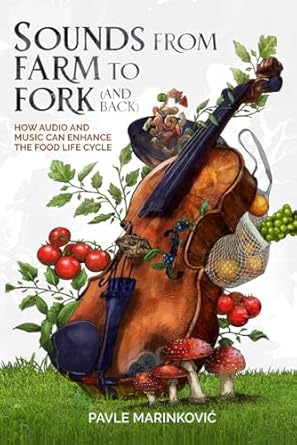
We’ve never thought about linking food and music in this way where they interact. It’s not just that you have food while you’re eating. It’s what’s music doing to your perception of taste? Is it also changing the pace at which you eat? How can you use music to enhance plant growth, make the plants more robust, and use fewer pesticides? How can you interact with music at every stage of the cycle? Until now, nobody has ever compiled all these different studies on this. I wanted to take that challenge and put them all in one book.
You’re a pioneer in this idea. Like you said, compiling all of this in one book, which I feel is so fascinating and anybody that is in different industries can relate. That’s what’s fascinating about this book. Is it true? Correct me if I’m wrong, but if I’m in the kitchen and I’m cooking and I’m playing music, my favorite music, that’s going to create the situation in which I’m going to be more apt to eat more.
Depending on if it’s fast-paced music and if it’s louder, it makes you focus more on the music than on the food so maybe you’re not aware that you’re eating. You overeat because you are more focused on the music that you enjoy so much. This is what happens in bars a lot. They put on loud music, people just drink more because it’s awkward to be looking at each other without saying anything. If you say something, nobody’s going to hear it because it’s too loud. What do you do? You just drink more.
You drink more and you talk less as the hours go by, that’s fascinating but they also want you to drink more and just leave so that other customers come in. That’s the whole idea too.
That’s how unconsciously you are more anxious to be moving because it’s fast space music and it’s sending signals that you have to move to do something different, not just stay in one place.
Marketers’ Relationship With Healthcare
How do marketers relate to healthcare? I understand that there is a correlation there. Could you expand on that?
First, food marketers, what do they do? They try to highlight the features of their product. They do that visually, mainly, but they also use sound when you want to boost the crunchiness of chips in a commercial. It makes the food more appealing. It’s very difficult not to want to have a Coke after you hear the can pop and hear its fizzing sound.
These properties can also be used in healthcare. For instance, cancer patients with reduced taste sensitivity after chemotherapy might find food tastier by enhancing its sound. If you boost the sound element of the food, let’s say you give them headphones to amplify the crispiness while they eat, or as we saw with the experiment with chocolate, use high-pitched sounds to enhance the sweetness of the food they’re eating. It can help them enjoy the food more. There’s also another way you can use sounds, that is to choose healthier foods, for instance, those with less sugar.
There was a coffee chain in Shanghai that introduced what they call a Sonic Sweetener. It was a device inserted in cups that emitted a pink light and a high-pitched sound that made the drink taste sweeter without sugar. You would tilt the coffee cup and that would activate the sound and the light. This reduced the need for actual sweeteners because the logic was since it already tastes sweeter, you don’t need any more sugar in it. All this shows that if we can harness the power of sound, there’s so much more we can do.
If we can harness the power of sound, there’s so much more we can do.
I also read in your book talking about another facet of it is how it’s used with meats, with livestock, and how it kills bacteria. I find that super fascinating because if that works in that industry, the potential that we have as humans, we still have a long way to go to take advantage of it. If you can expand on that.
When you learn how music interacts with these different elements in the food, like the bacteria, when you use ultrasounds to kill bacteria, and if you combine this with other elements as well, you can get to a rate of 99% of killing all these bacteria. You’re able to use music more consciously, knowing which results to expect. Knowledge helps us not only understand the world but mold it to our benefit. As the saying, “With knowledge, comes power.”
Knowledge helps us not only understand the world but also mold it to our benefit.
This book is ahead of its time because it talks about all of the different industries in which sound is used to combat bacteria and also influences our brains. There’s still so much that we need to learn about sound and music and also use in industries like healthcare. When I hear the word bacteria, the first thing I think of is, “Let’s just hope that in years to come, the medical industry will open up to these innovative ideas, because if it works with livestock, I can imagine what it can do to human beings.”
What do they say that we are? 60% water at least, and that makes the vibration interact with our bodies and change the unexplored topics. There’s so much more we can find that we just need to focus more on these different instances, not just because we usually think about music as something entertaining. Something that you can play an instrument or you can listen to music or dance to it. We don’t see that there’s so much more to music. If you just think in economic terms, it’s cost-effective, it’s accessible, and it doesn’t have major secondary effects. There are so many benefits to just using this element that it’s everywhere and we just have to harness this power.
Pavle, I tell you, after reading your book, when I go to the supermarket and I’m about to grab a dozen eggs, it makes me think now, I wonder if those chickens that laid those eggs were under the influence of sound. When I’m going to buy a piece of meat, I think the same. After reading the book, you start thinking differently about what you consume. I’m wondering if there have been times when I think something is so delicious. It just makes you think.
Maybe they could put up a label, instead of grass-fed, music-fed.
Influenced by sound.
That would be awesome, yes.
Music In Film Scoring
What about film scoring? When we go and watch a movie, of course, we’re influenced by the sound. Can we explore this a little bit? I know that you compose music for films. Is that right? You’ve done that.
Yes. When I was in film score music in Barcelona, they always told us, “If people realize they’re more focused on the music, you’re not doing your job well.” It has to be seamlessly integrated into the movie. It doesn’t have to steer your attention away from the screen, from the visuals, because that’s how it’s more powerful. You just have to see a horror movie. If you take away the music, it’s not scary anymore.
Sound has such an impact that it can change how we feel, and the amount of time we feel it fast but if it’s fast-paced, we think, “Everything is going too fast.” Many elements interact and as film composers, you also work alongside the director all the time, trying to figure out what is his intention behind a certain scene. As a film composer, you should be able to say, the scene doesn’t need music. You just have to portray the scene. It’s more impactful if it’s just in silence, like no music at all. You also have to be aware that if you put too much music everywhere, it’s going to lose its effect.
I want to share with you something that I have always wondered about. When I go to a movie that I’m enjoying, you know what happens to me? This has happened for a long time. When I’m enjoying a movie, Pavle, I look at the time and not because I want it to end. I just want to see how much more time I have to enjoy the movie. That’s strange. Have you ever heard of anybody saying that to you? No?
I would assume the other way. If you’re looking at your watch, it’s like, “When can I leave?”
No. To me, it’s the total opposite. I’m like, “I’m enjoying this. I hope it doesn’t end. Let me see what time it is. Oh, yes. I still have this much more time to enjoy it.” Isn’t that weird? Strange?
Everybody experiences these art forms differently. If we were all the same, it would be so boring. We wouldn’t know it’s a variety.
Everybody experiences art forms differently. If we were all the same, it would be so boring.
Sensory Awareness
Have you ever analyzed yourself? I’m curious. Since, you know, you’ve been in this field for so many years and since you have in the same way by reading your books, by reading your writing. All of these things make us more aware of our senses. Are you aware of your senses when you go to a restaurant, or when you go to movies? How does that affect you? Do you lose less interest since you’re part of the creation of what happens behind the scenes?
Yes, I think I’m too aware of the sound elements, but maybe not as much of the smell or the visuals. Maybe I’m more drawn to somebody asking me if I go somewhere, ”Did you see that person?” “No, I heard them. They had a nice voice.” Instead of looking at certain features in their face. I guess as musicians, maybe you get more prone to think about sound instead of other elements.
Do you know what’s happening to me now after reading your material, I go to the supermarket and I am more aware now than ever, not only the visual, because I told you before, that when I go to a supermarket, I just want the supermarket to be mine. I want to own it because of the colors and the way they are structured, I know there are consultants, and there are people out there who work on the psychology of the visual.
Now that I go to a supermarket, I go to a store, and I say to myself, “Wait a minute now, the music that’s playing is playing on my psychology somehow.” When I go to the mall, I say to myself, “Now I have to control what I’m going to buy. I have to control not to spend so much money.” That’s what happens when you start learning more about these things.
Exactly and it has less influence on you because you are more aware. It doesn’t penetrate all these barriers, these awareness barriers have. It has less toll on you. When we were talking about a film score inside a movie, if you’re paying attention to the music, you’re already out of the scene, out of the narrative, out of the engagement with the characters. The same happens when you go to a store. If you say, “Now you’re trying to get me with fast-paced music and get me out of the store. No. I’m not going to react to this.”
Yes, you resist it. That’s awesome. You have very interesting, very educational, hypnotic information that you always write via a medium. I want to also let our readers know how important it is to educate ourselves on all those things on how powerful sound and music are to connect to our senses. That’s what we do in the show.
We create awareness of how important it is to connect to our senses because that in the long term affects the positive way our brain health and our health in general. You are such a big part of this. I thank you so much, Pavle, for joining me on the show and creating awareness of how important sound is to the psyche.
Thank you for this opportunity.
Thank you so much. How can we find you? I know you’re on LinkedIn, right?
Yes, I’m on LinkedIn. I always write there. I link to my articles there as well. On Medium, I have a newsletter. Now I had to change from Substack to Beehive. I’ll send you the links.
You’re also in Sound Awareness, correct?
It’s called Sound Awareness, but just the provider is different. Also, I got my book.
Yes, and your book. It’s going to be in the notes. You’re funny.
I got it physically until now. It was just online when you read it. It was just on Kindle or online formats, but now I have a physical.
You have to translate it Pavle, in different languages.
Yes. Spanish first.
Listen, more people got to know about it. Yes. That’s a very important topic. Thank you so much, Pavle. We’ll be talking soon.
Thank you very much, Lucy. Bye bye.
 Your Ageless Musical Brain Podcast LLC.